Subtotal $0.00
I have always dreamt of driving myself through Queen Elizabeth National Park, but I am terrified of getting a flat tyre in the middle of nowhere with no phone signal. What do real drivers do in Uganda?
You breathe. You laugh about it later. And you realise that a puncture is not the end of your safari it is just a 30-minute pause in the adventure. As a tour operator who has sent several of self-drive travellers across this beautiful country, I promise you that every single person who explores Uganda by road eventually meets a flat tyre. The secret is not avoiding it. The secret is knowing exactly what to do when it happens. And by the time you finish reading this guide, you will know more than most Ugandan boda boda riders.
Is self-drive safe in Uganda? I keep hearing stories about bandits and bad roads.
Let me stop you right there. Uganda is one of the most welcoming and safest countries for self-drive tourism in East Africa. Thousands of travellers each year rent a Rav4 or a Toyota Land Cruiser and drive themselves from Entebbe all the way to Murchison Falls, Kibale Forest, and even the remote Kidepo Valley. The roads are an adventure some are smooth tarmac, others are rugged dirt tracks that rattle your bones. That is not danger. That is the real Africa. Theft and banditry are extremely rare on the main tourist circuits. What you will encounter is friendly wave from children, goats crossing the road without warning, and the occasional herd of Ankole cattle taking over the highway. If you drive cautiously and respectfully, Uganda will treat you like family.
What is the most common problem self-drivers face in Uganda?
Without question punctures. The roads here have a personality. After a heavy rain, the laterite surfaces hide sharp rocks. During the dry season, the corrugations wear down your tyres faster than you expect. A flat tyre is not a sign of bad luck. It is a normal part of driving in equatorial Africa. That is why every rental car fleet in Uganda carries a full-size spare tyre, a scissor jack, and a wheel wrench. The question is not if you will get a puncture. The question is whether you will be ready when it happens.
Best Self-Drive Destinations in Uganda (Where the Punctures Are Worth It)
Before we get our hands dirty changing a wheel, let me convince you why driving yourself is the only way to see these places. When you are behind the wheel of your own rental car, you stop when you want. You stay as long as you want. You chase that elephant down a side track without waiting for a tour guide to finish their cigarette. That freedom is priceless.
Queen Elizabeth National Park.
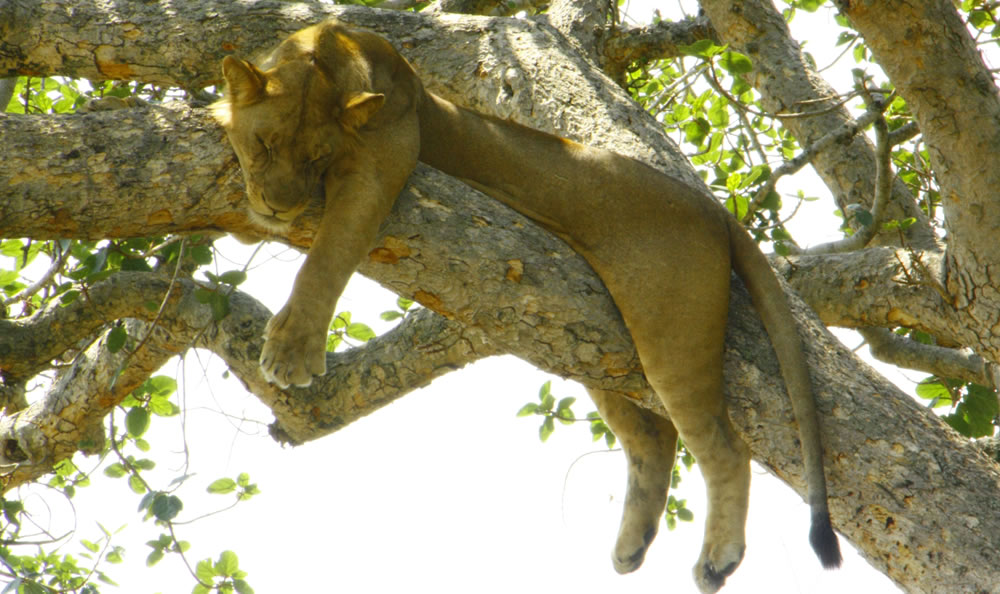
This is your ultimate self-drive playground. The park has over 100 kilometres of well-maintained tracks that loop through savannah, acacia woodland, and along the Kazinga Channel. You can drive yourself to see elephants, lions, hippos, and buffalo without a ranger in sight. The Ishasha sector in the south is famous for its tree-climbing lions lounging in fig trees like oversized house cats. The roads are bumpy but passable in a 2WD during dry months. A 4×4 opens up more tracks and gives you peace of mind when the afternoon rains turn the clay into black ice.
Murchison Falls National Park.
Nothing prepares you for the moment you drive through the park gates and see the Nile River thundering through a 7-metre gap in the rocks. The self-drive experience here is spectacular. The northern circuit takes you through open grassland where giraffes, hartebeest, and oribi graze right next to the road. The Delta area requires a proper 4×4 and is worth every muddy moment. Budget at least two full days to cover the 200 kilometres of tracks. Remember to carry extra fuel the park has a petrol station but it runs out more often than not.
Lake Mburo National Park.
If you want to practice your self-drive skills, start here. This compact park is only a three-hour drive from Kampala along smooth tarmac. The tracks inside are gentle and clearly marked. Zebras and impalas are everywhere. Elands browse near the roadside. The park is small enough that you cannot get seriously lost, but wild enough to feel genuinely remote. It is perfect for a weekend shakedown before tackling the bigger parks.
Kidepo Valley National Park.
This is for the brave. Kidepo sits in the far northeastern corner of Uganda, a long day’s drive from Kampala even on good roads. The park is vast, wild, and virtually empty of tourists. The self-drive experience here is as raw as Africa gets. You need a proper 4×4 with high clearance and very good tyres. A puncture here is not a small inconvenience it is an adventure. But the reward is watching cheetahs hunt on open plains without another vehicle in sight. If you go, take two spares, extra water, and a satellite phone or a reliable GPS messenger.
Key Factors When Hiring a Self-Drive Car in Uganda
Choosing the right vehicle is more important than choosing the right hotel. A bad car will ruin your trip before it starts. Here is what you need to know.
4×4 or Not 4×4?
For the main roads between Kampala, Fort Portal, and Mbarara, a 2WD Rav4 is fine. The tarmac is mostly good. But the moment you turn off onto a park track or a rural murram road, you will wish you had four-wheel drive. The rainy seasons from March to May and September to November turn dirt roads into slippery nightmares. A 2WD will spin its wheels while a 4×4 crawls past without effort. Do not risk your safari to save a few dollars a day. Rent a Toyota Land Cruiser TX, a Safari Van, or the Safari Land Cruiser Extended. They are built for these conditions.
Ground Clearance Matters.
Those deep ruts in the road are not just annoying they can beach your car like a whale on a sandbar. A standard saloon car will scrape its underside on every rock. A Rav4 has decent clearance. A Land Cruiser laughs at obstacles. When you inspect your rental vehicle, get on your knees and look underneath. Does the exhaust pipe hang low? Are the suspension components exposed? The ideal self-drive car for Uganda has at least 210 millimetres of ground clearance.
The Spare Tyre Rule.
Before you sign any rental agreement, open the boot and check the spare tyre. Is it a full-size tyre or a skinny space-saver? A space-saver is fine for getting to the next town, but not for continuing your safari. Insist on a full-size spare that matches the other four tyres. Check its pressure with your own gauge. I cannot count how many travellers have called me from the roadside with a flat spare and a sad voice.
Insurance and Breakdown Cover
Read the fine print. Most Ugandan rental companies include basic comprehensive insurance, but the excess can be high. Some policies do not cover tyres, windscreens, or underbody damage. Ask these questions before you pay. A good operator will offer optional tyre and windscreen cover for a small daily fee. Take it. It will pay for itself the first time you hit a pothole the size of a bathtub.
Where to Witness and Check Your Vehicle Before You Drive
You have chosen your car and paid your deposit. Now it is time to put on your mechanic hat for ten minutes. Do not rush this. A thorough pre-rental inspection will save you hours of arguing later.
Start with the Tyres
Walk around the car slowly. Look at each tyre’s tread depth. The legal minimum in Uganda is 1.6 millimeters, but you want at least 4 millimeters for safari driving. Check for uneven wear—that indicates alignment problems or worn suspension. Run your hand over the sidewalls to feel for cracks, bulges, or cuts. Any visible damage is a red flag. Ask for a different car.
The Spare Tyre and Jack
Open the boot. The spare tyre should be secure and easy to reach. Take it out and check its pressure. While you are there, locate the scissor jack, the wheel wrench, and the vehicle owner’s manual. Operate the jack through one full cycle to make sure it moves smoothly. Test the wheel wrench on one nut to confirm it fits. These tools sit untouched for months until the moment you need them. Make sure they work.
Under the Bonnet and Under the Car
Open the bonnet. The oil level should be between the minimum and maximum marks. The coolant reservoir should be filled. The windscreen washer bottle should have fluid. These are basic. Now get down on your hands and knees and look underneath the car. Are there any fresh oil stains on the ground? Does the exhaust system look solid? Is the sump guard still attached? A car that leaks oil before you start is a car that will leave you stranded.
The Test Drive
Do not skip this. Drive the car for at least fifteen minutes on a mix of smooth and rough roads. Listen for squeaks, rattles, and clunks. Feel how the steering responds. Brake hard from 60 kilometres per hour to check for pulling or vibrations. Pay attention to the gearbox does it shift smoothly? If anything feels wrong, return to the rental office and ask for a different vehicle.
Complete Guide: How to Change a Puncture on a Uganda Self-Drive Safari
Pull over, take a breath, and follow these steps exactly. The whole process takes about thirty minutes when you know what you are doing.
Tools You Need (They Are in Your Car)
Spare tyre – Check its pressure before you set off each morning.
Scissor jack – The one that came with your vehicle is fine for roadside changes. Ugandan jacks are tough.
Wheel wrench – The L-shaped or cross-shaped bar used to loosen and tighten wheel nuts.
Vehicle owner’s manual – Contains the exact jack placement points for your specific model.
Reflective warning triangles or flares – Place these behind your vehicle before doing anything else.
Gloves – Optional but strongly recommended. Wheel nuts and tyres are dirty, sharp-edged, and hot from African sun.
Torch – Essential if the flat occurs at night. Pack a good one in your day bag.
What Makes Uganda Different
Ugandan roads are not European motorways. When you stop, you are sharing the road with matatus (minibus taxis), overloaded Lorries, and boda bodas. Expect the unexpected. A goat may wander over to watch you work. A local may stop to offer help. Accept the help if you want it, but stay aware of your surroundings. And remember the sun sets fast near the equator. You have about fifteen minutes of usable light after sunset. Do not let that catch you with a wheel off the ground.
Step One: Stop Safely and Prepare
Pull off the road as far as possible onto a flat, stable surface. Avoid stopping on a slope a vehicle on a jack on uneven ground is genuinely dangerous. Turn on your hazard lights immediately, apply the handbrake firmly, and if you have them, place warning triangles at least 45 metres behind your vehicle. Ugandan drivers are not always expecting a stationary car. Give them space to see you.
If your car has a manual transmission, leave it in gear after applying the handbrake. For automatic vehicles, select Park. Find a large rock or a heavy piece of wood and place it against the tyre diagonally opposite the one you are changing. This prevents any rolling movement while the vehicle is raised.
Step Two: Loosen the Wheel Nuts before Jacking
This step is critical and frequently skipped by first-timers. Loosen each wheel nut by half a turn while the tyre is still fully in contact with the ground. Do not remove them just break the resistance.
If you try to loosen the nuts after the vehicle is jacked up, the wheel spins freely, and the wrench achieves nothing. With the tyre on the ground, it stays fixed, and the full force of your weight on the wrench does the work.
Turn each nut counterclockwise. If a nut is extremely tight, stand on the wrench arm and use your body weight rather than arm strength alone. Ugandan tyre fitters use impact wrenches set to “very tight.” You may need to bounce gently on the wrench handle.
Step Three: Position the Jack Correctly
This is where most first-time tyre changes go wrong. Placing the jack in the wrong position can damage the vehicle’s undercarriage or cause the car to slip off the jack entirely.
Open your owner’s manual and locate the jack points reinforced sections of the vehicle’s frame specifically designed to bear the load. They are typically marked by small notches or arrows along the metal sill running beneath the doors. Place the jack head directly under the correct point for the wheel you are changing. Never place it under a plastic body panel or a random section of the floor.
Raise the vehicle until the flat tyre clears the ground by approximately fifteen centimetres enough to remove the flat and fit the inflated spare without the vehicle settling back down as you work.
Step Four: Remove, Replace, and Tighten in the Right Order
Remove the loosened wheel nuts completely. Keep them in your pocket or a small container they are easy to lose in long grass. Pull the flat tyre straight toward you and set it aside. Lift the spare tyre onto the hub, aligning the holes with the bolts. Hand-tighten each nut as far as possible before using the wrench.
Now tighten the nuts in a star pattern not in a circle. This distributes pressure evenly across the wheel and prevents warping.
Tighten the top nut first.
Move to the nut directly opposite—bottom.
Move to the right nut.
Move to the nut directly opposite—left.
Continue in this cross pattern until all nuts are firm.
Lower the vehicle completely, remove the jack, and then tighten each nut again with the wrench as hard as you can. The wheel needs to be firmly seated before you drive.
After the Change: What Most Guides Leave Out
You have changed the tyre. Well done. But you are not finished.
Check the spare tyre’s pressure as soon as you reach a petrol station.
Space-saver spare tyres (the narrower temporary ones) are typically inflated to 420 kPa (60 psi) significantly higher than a standard tyre. If you are driving a Safari Van or Land Cruiser with a full-size spare, the pressure should match the other tyres.
Space-saver spares have a maximum speed limit of 80 kilometres per hour and should not be driven more than 80 to 100 kilometres. They are not a permanent solution. If you are in a remote area like Kidepo, drive slowly and carefully to the nearest town.
Have your wheel nuts torqued to the manufacturer’s specification at a garage within 50 kilometres of the change. A roadside tightening by hand and wrench is sufficient to get moving, but not a substitute for proper torque.
Repair or replace the damaged tyre promptly. Driving without a functional spare is a risk no driver should accept. Almost every town in Uganda has a roadside tyre repair shop. They are cheap, fast, and skilled.
Final Word from One Traveller to Another
The first time you change a tyre by the side of a Ugandan road, it feels like a long and uncertain process. The second time, it feels like something you simply know how to do. That shift from helpless to capable is worth more than the thirty minutes it takes to learn.
You are not just renting a car. You are renting freedom. You are choosing to wake up when you want, stop when you see something beautiful, and drive yourself through the most stunning landscapes on earth. A flat tyre is a tiny price to pay for that privilege.
Ready to hit the road? Explore our fleet of Rav4s, Toyota Land Cruiser TXs, Safari Vans, Safari Land Cruiser Extended, and other tough vehicles at selfdrivinguganda.com. We will hand you the keys, show you where the jack is hiding, and send you off with a smile. The punctures are waiting. But now, so are you.
Safe driving. Happy safari. And may your spare always be inflated.